Is AI actually dangerous for everyday users?
Not in the dramatic sense that headlines sometimes suggest. For most everyday users, the realistic risks are privacy exposure, misinformation, algorithmic bias, and overreliance on tools that can be confidently wrong, not the more sensational scenarios sometimes discussed in media coverage or science fiction.
That does not mean the risks are zero or not worth attention. It means the useful response is informed awareness rather than fear. Understanding what can actually go wrong, and how to manage it, gives you more control than either blind trust in AI or blanket avoidance of it.
What is AI bias, and why does it happen?
AI bias happens when a system produces unfair or skewed outcomes, usually because the data it learned from reflects existing patterns and inequalities in society rather than because anyone deliberately programmed unfairness. The system is not choosing to discriminate, it is reproducing patterns it found in its training data.
A commonly cited example: a hiring tool trained mostly on past resumes from one demographic group can end up favoring similar resumes going forward, even if no one intended that outcome. Bias can also creep in through how data is collected, if a group is underrepresented in the data a system learns from, its performance for that group tends to suffer.
Addressing bias requires deliberate effort: auditing training data for skew, testing outcomes across different groups, and monitoring systems after deployment rather than assuming a one-time fix solves the problem permanently. This is ongoing work in the AI industry, not a solved problem, which is a reasonable thing to stay aware of when a tool is making decisions that affect you, like a loan or hiring screen.
As an everyday user, you generally cannot audit a company's training data yourself, but you can stay alert to outcomes that seem consistently unfair and raise questions when an automated decision, like a loan denial or a job application rejection, does not come with a clear explanation. Companies are increasingly expected to explain automated decisions, and asking for that explanation is a reasonable, low-effort form of accountability.
What should you know about AI and data privacy?
Most AI chat tools may use what you type to improve their systems unless you turn that setting off, so nothing you paste into a chatbot should be treated as fully private by default. This is standard industry practice, not a sign that a particular tool is unusually invasive.
A simple rule of thumb covers most of the risk: if you would not want something sitting in a company's training data or reviewed by a support agent, do not type it into a chat tool. That includes passwords, full financial account numbers, medical details, and confidential work information. Our AI data security guide covers the specific settings worth checking on popular platforms.
Will AI cause widespread job displacement?
AI is more likely to change jobs by automating specific tasks than to eliminate entire professions wholesale. Repetitive, rules-based work is the most exposed, while work built around judgment, creativity, negotiation, or human connection tends to be far more resistant to automation.
That said, some roles really will shrink, particularly ones concentrated almost entirely around tasks AI now handles well, so the disruption is real even if "every job disappears" is an exaggeration. The most useful response for most people is staying aware of which parts of a job are shifting and building skills that complement rather than compete with automation.
History offers a partial, imperfect guide here: past waves of automation displaced specific tasks and roles while also creating new ones that did not previously exist, and the transition was difficult for many workers along the way. AI is not guaranteed to follow the exact same pattern, but "difficult and uneven" is a more accurate expectation than either "no impact" or "total replacement."
How worried should you be about AI misinformation and deepfakes?
Worried enough to build a habit of quick verification, not worried enough to distrust everything you encounter online. AI-generated deepfakes, fake images, and fabricated text are genuinely harder to detect than they used to be, which makes a moment of skepticism before sharing surprising or emotionally charged content a reasonable, proportionate habit.
A few practical habits help: check whether a claim appears on a reputable, independent source before sharing it, be extra cautious with content designed to provoke a strong emotional reaction, and remember that a convincing voice or video is no longer reliable proof that something is real. This applies to scams too, our guide to AI for seniors covers AI voice-clone scams specifically and a family verification habit that defeats most of them.
Is the idea of dangerous, uncontrollable AI realistic today?
For the AI tools available to everyday consumers, no. Current AI systems are narrow, meaning they are built to perform specific tasks, like generating text or recognizing images, without general reasoning, independent goals, or awareness beyond the task in front of them.
The more dramatic long-term scenarios discussed in some research and science fiction contexts are a truly separate conversation from the everyday risks that affect typical users right now. It is reasonable to be curious about that longer-term discussion without letting it distract from the practical, present-day habits, checking sources, protecting your data, and applying healthy skepticism, that address the overwhelming majority of real-world risk.
How do these risks connect to ethics more broadly?
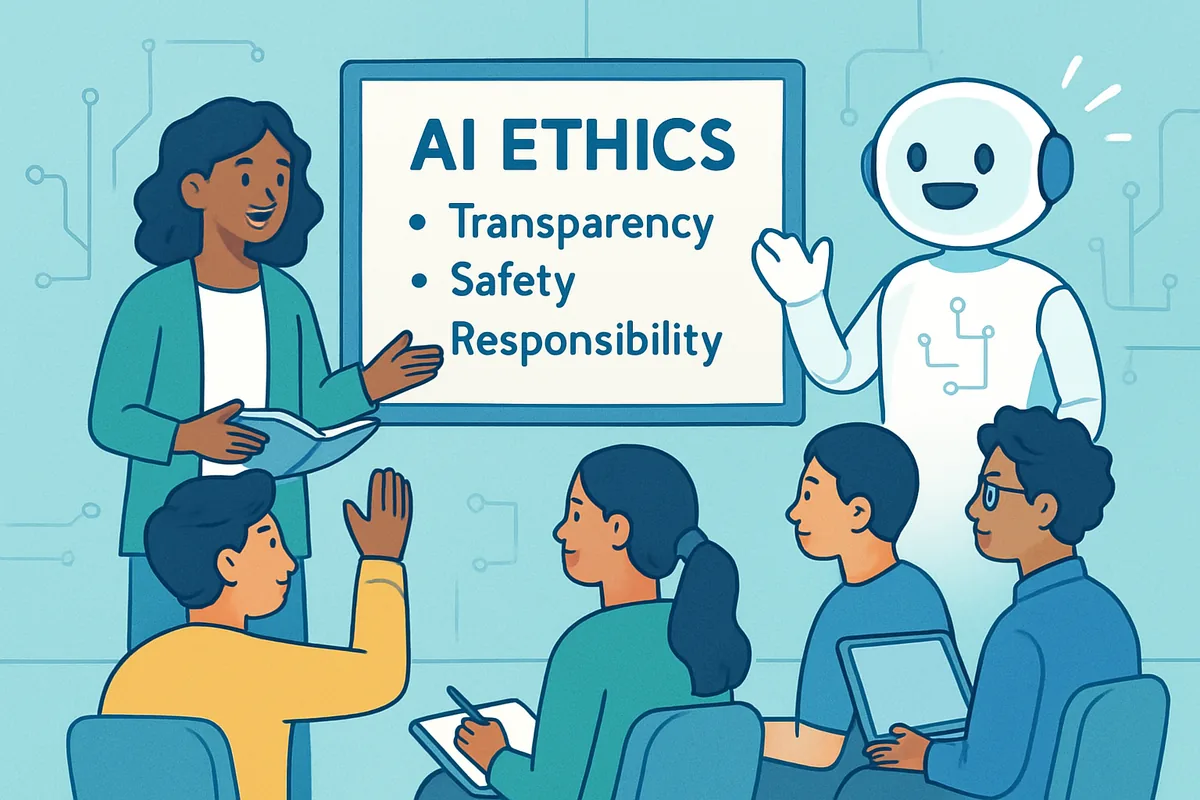
Bias, privacy, misinformation, and job displacement are ultimately ethics questions as much as technical ones, since they involve who benefits, who is harmed, and who gets a say in how AI systems are built and deployed. Being an informed user, rather than a passive one, is a meaningful part of navigating that landscape responsibly.
Our roundup of common AI myths tackles some of the more sensational claims directly, separating what is realistic from what makes for a better headline than an accurate one. If you are having this conversation with a child, our kid-friendly guide to artificial intelligence covers the same underlying ideas in age-appropriate language.
Next step: for the full picture on AI safety, including data privacy settings and scam awareness, visit our AI safety hub.