Why does AI terminology feel so overwhelming?
AI terminology feels overwhelming mainly because the same handful of underlying ideas get described with several different words depending on the context, whether that is a research paper, a product page, or a casual conversation. Once you can map those words back to a small number of core concepts, the jargon stops feeling like a moving target.
This glossary groups 25 terms into four practical clusters: foundational concepts, training vocabulary, words you will see while actually using a chat assistant, and terms that matter once you start connecting AI to other tools. Read it top to bottom for a full picture, or jump to whichever section matches what you are trying to understand right now.
What are the foundational AI terms everyone should know?
A small handful of terms form the backbone of almost every AI conversation: artificial intelligence, machine learning, deep learning, and neural networks. Understanding how these four relate to each other, as nested concepts rather than separate technologies, makes the rest of the glossary click into place faster.
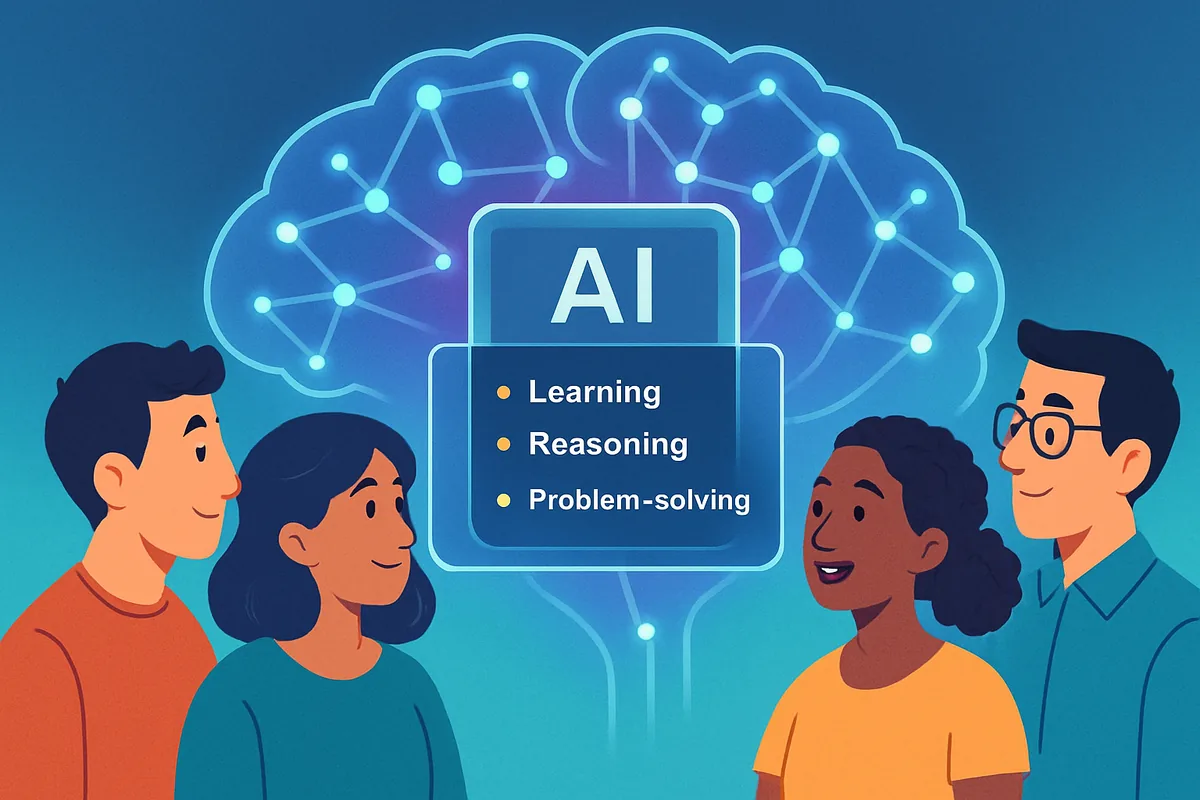
- Artificial Intelligence (AI): the broad goal of building systems that can perform tasks normally requiring human intelligence, like problem-solving, learning, and language understanding.
- Machine Learning (ML): a subset of AI where systems learn patterns from data instead of following explicitly programmed rules, improving as they see more examples.
- Deep Learning (DL): a more advanced form of machine learning that uses layered neural networks, well suited to complex tasks like image recognition and language generation.
- Neural Network: a structure of interconnected nodes loosely inspired by the brain, which processes information in layers to recognize patterns. For a full breakdown, see our machine learning vs deep learning vs neural networks guide.
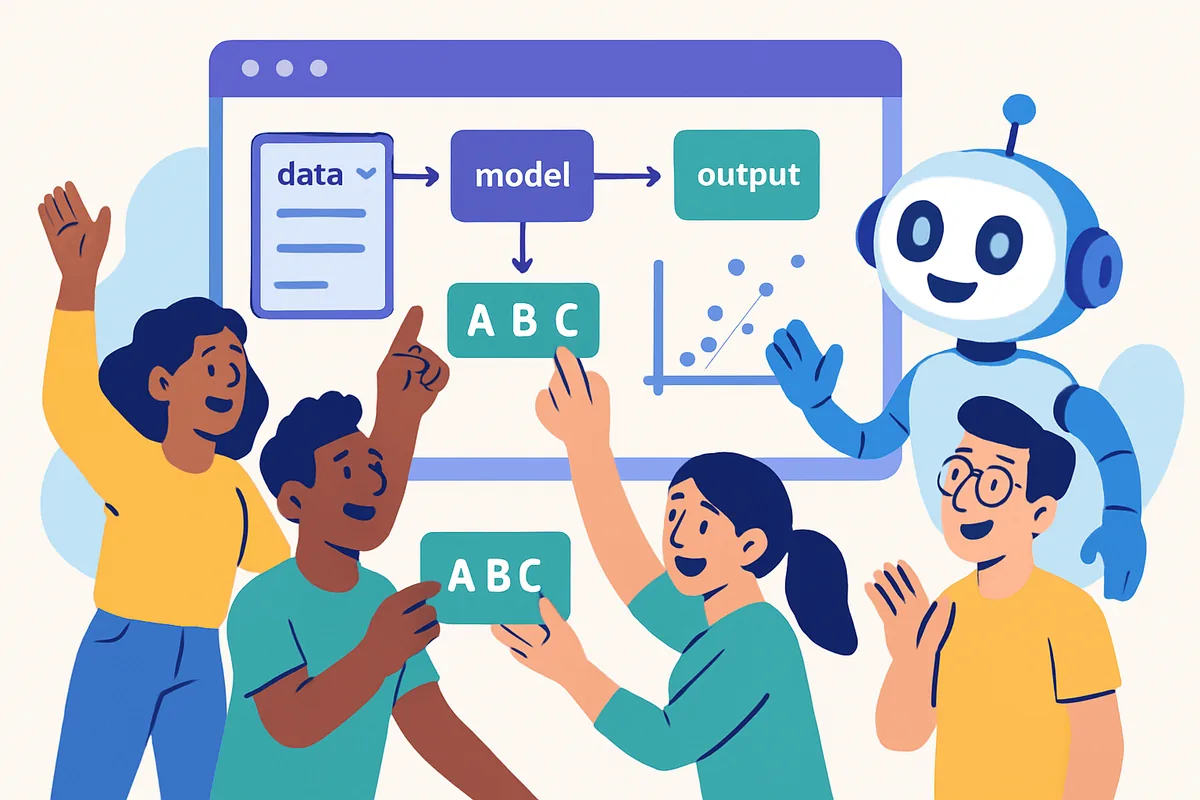
- Algorithm: the set of instructions a computer follows to process data and reach a result. In AI, algorithms are what turn training data into a usable model.
- Model: the output of an AI training process, representing everything the system learned from its training data. When you use ChatGPT or Claude, you are interacting with a model.
What terms describe how AI models are trained?
Training-related terms describe the data and process behind building a model, which helps explain both a model's strengths and its blind spots. The quality and scope of training data directly shapes what a model can and cannot do well.
- Data Set: a collection of data used to train and test an AI model. Larger, higher-quality datasets generally produce more capable models.
- Training Data: the portion of a dataset used to teach a model, from which it learns patterns and relationships.
- Testing Data: a separate portion of data used to evaluate a trained model's performance on examples it has not seen before.
- Supervised Learning: training on labeled data, where the correct answer is provided for each example, similar to learning with a teacher.
- Unsupervised Learning: training on unlabeled data, where the model finds patterns and structure on its own without being told the "right" answer in advance.
- Fine-tuning: taking a pre-trained model and training it further on a narrower dataset to improve its performance on a specific task.
- Bias: systematic errors in an AI model's output caused by skewed or unrepresentative training data, which can show up as unfair or inaccurate results for certain groups or topics.
What terms show up when you actually use a chat assistant?
Once you start using tools like ChatGPT, Claude, or Gemini directly, a different set of terms becomes relevant: prompt, token, LLM, and generative AI. These describe the interaction itself rather than what happens behind the scenes during training. Our guide to how ChatGPT works walks through several of these terms in the context of one specific assistant.
- Large Language Model (LLM): a model trained on massive amounts of text, capable of generating human-quality writing, answering questions, and translating languages. LLMs power ChatGPT, Claude, Gemini, and most modern chat assistants.
- Prompt: the input text or instructions you give an AI model to generate a response. More specific prompts, including desired tone or format, generally produce better results.
- Token: a basic unit of text that a language model processes, usually a word or part of a word. Longer conversations and documents use more tokens, which affects a model's usable context.
- Generative AI: AI systems that create new content, such as text, images, audio, or video, rather than just classifying or analyzing existing data.
- Chatbot: an AI-powered program that simulates conversation with a human, usually through text. Modern chat assistants are a much more capable evolution of earlier rule-based chatbots.
- Natural Language Processing (NLP): the field of AI focused on enabling computers to understand, interpret, and generate human language, which underlies chatbots and translation tools.
- Zero-Shot Learning: a model's ability to perform a task correctly without having seen specific training examples for that exact task, relying instead on general patterns it learned elsewhere.
What terms matter once you start building with or around AI?
A final group of terms becomes relevant once you start connecting AI to other tools, whether that means using a developer API or a no-code automation platform. These describe how AI fits into a broader workflow rather than a single conversation.
- Computer Vision: a field of AI focused on enabling computers to interpret images and video, used in tools ranging from photo organization to quality inspection.
- API (Application Programming Interface): a set of rules that lets different software systems communicate with each other. Many AI tools offer an API so developers can integrate them into other products.
- Integration: connecting different software systems so they work together, such as linking an AI tool to a customer relationship management system to automatically log conversation summaries.
- Automation: using technology to perform tasks automatically with minimal human intervention. AI is increasingly used to make automation smarter, not just faster.
- Scenario: a specific automated workflow built inside a no-code automation platform, connecting apps and AI tools to perform a task without writing code. Our no-code automation hub covers how these workflows fit together in more depth.
Next step: once these terms feel familiar, our AI models hub puts them into practice by comparing ChatGPT, Claude, Gemini, and Copilot side by side.