What is machine learning, and how is it different from traditional programming?
Machine learning is a way of teaching computers to learn from data instead of following a fixed set of programmed rules for every possible situation. Rather than manually specifying every case, you feed the system data and let it identify patterns on its own.
A classic example is spam detection. Traditional programming would require manually defining rules like flagging any email containing specific words. Machine learning instead learns from a large set of labeled spam and non-spam emails, picking up on patterns like word frequency, sender behavior, and message structure that a human might not think to hard-code.
What is deep learning, and how does it relate to machine learning?
Deep learning is a subfield of machine learning that uses neural networks with many layers, which is where the word "deep" comes from. Those extra layers let deep learning systems handle more complex patterns than traditional machine learning techniques, like recognizing objects in images or generating coherent text.
A useful way to picture the difference: simpler machine learning is like teaching a system to recognize cats by showing it labeled cat photos and defining a few key features. Deep learning is more like letting the system discover on its own what makes something look like a cat, without being told which features matter in advance.
What are neural networks, exactly?
Neural networks are the underlying structure that deep learning is built on, made of interconnected nodes organized in layers, loosely inspired by how neurons connect in the brain. Each connection carries a weight, and training adjusts those weights so the network gets better at producing accurate output.
A neural network typically has an input layer, one or more hidden layers, and an output layer. Data flows through these layers, with each layer transforming it slightly, until the final layer produces a prediction, classification, or generated response. More hidden layers generally means the network can represent more complex patterns, which is the core idea behind "deep" learning.
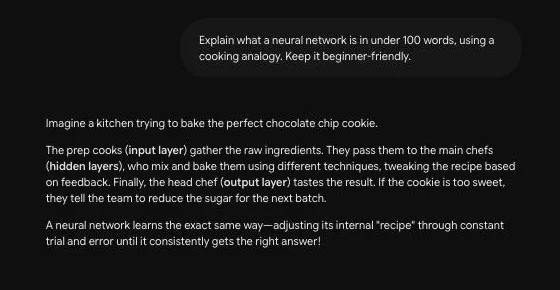
My favorite way to make this concrete: I asked Gemini to explain a neural network with a cooking analogy, and it mapped every technical term onto a bakery. Prep cooks gather ingredients (the input layer), chefs mix and bake with different techniques (the hidden layers), and the head chef tastes the result and sends feedback back to the team (the output layer plus training). Here is the actual response from my test on July 15, 2026.
How do AI, machine learning, deep learning, and neural networks fit together?
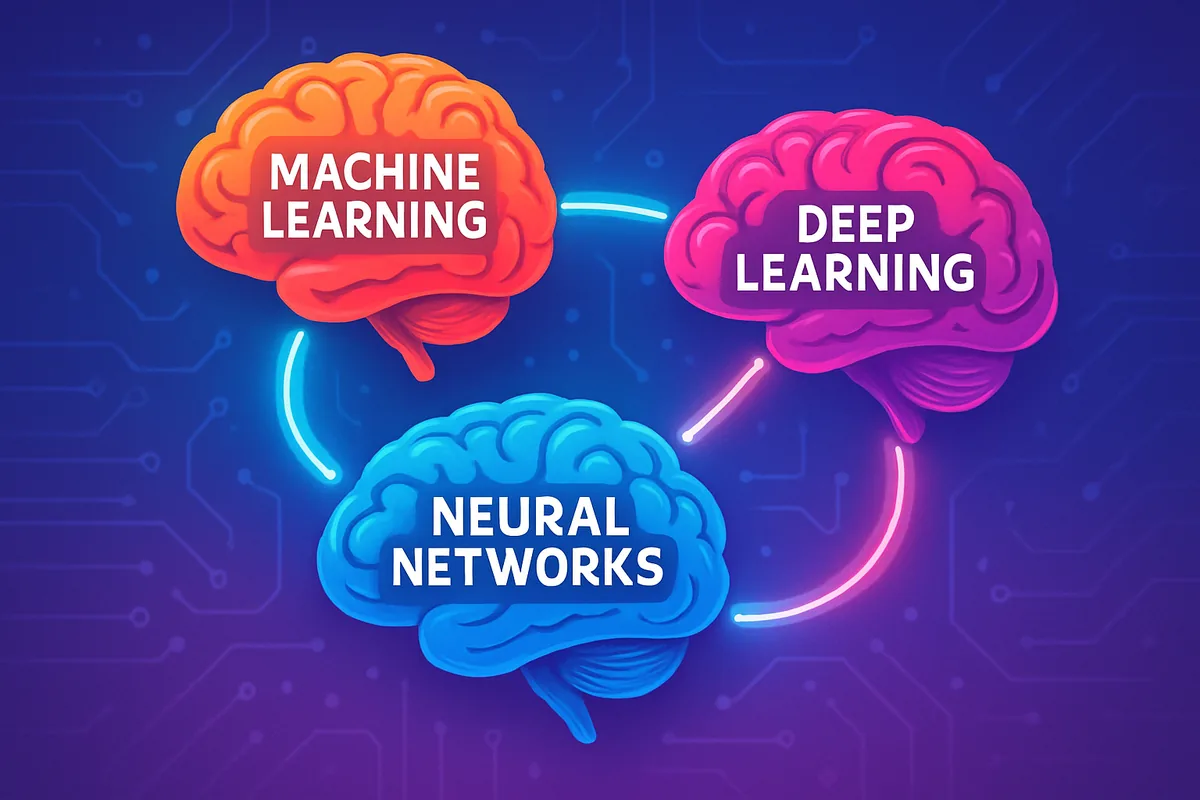
These four terms form a set of nested concepts rather than four separate technologies. AI is the broadest goal, machine learning is one approach within it, neural networks are a structure used within machine learning, and deep learning is machine learning that uses many-layered neural networks.
| Concept | What it is | Typical use | Relationship to the others |
|---|---|---|---|
| Artificial Intelligence | The broad goal of computers performing humanlike tasks | Umbrella term covering all approaches below | The outermost, broadest category |
| Machine Learning | Systems that learn patterns from data instead of fixed rules | Spam detection, fraud flags, basic predictions | A subset of AI |
| Neural Networks | Layered, interconnected structures loosely inspired by the brain | The building block used by deep learning models | A structure used within machine learning |
| Deep Learning | Machine learning using neural networks with many layers | Image recognition, language generation, complex pattern recognition | A subset of machine learning built on neural networks |
When does it make sense to use machine learning versus deep learning?
Simpler machine learning techniques are often faster, cheaper, and easier to explain, which makes them a good fit for straightforward tasks like spam detection or basic fraud flags. Deep learning tends to outperform simpler techniques on complex tasks like image recognition and language generation, but usually needs more data and computing power to do it well.
Chat assistants like ChatGPT, Claude, and Gemini are powered by deep learning, specifically a neural network architecture called a transformer trained on massive amounts of text. Our guide to how ChatGPT works walks through that specific example in more detail, and our AI glossary for beginners covers related terms like tokens and large language models.
What are some everyday examples of each approach in action?
You interact with all three levels of this hierarchy regularly, often without noticing which one is doing the work behind a given feature. Recognizing the difference helps explain why some AI features feel simple and predictable while others feel remarkably flexible.
- Machine learning example: a bank's fraud detection system flagging an unusual transaction based on patterns in your typical spending, using relatively simple models trained on transaction data.
- Neural network example: a basic image classifier sorting photos into categories like "receipt" or "screenshot" using a handful of layers.
- Deep learning example: a chat assistant generating a coherent, context-aware paragraph in response to your question, powered by a neural network with many layers trained on huge amounts of text.
The common thread across all three examples is learning from data rather than following fixed rules. What changes is the complexity of the pattern being learned and the depth of the network used to learn it.
Where does generative AI fit into all of this?
Generative AI is not a fourth separate category, but a use case built on deep learning. The chat assistants and image tools people call "generative AI" in 2026 are deep learning systems, usually large neural networks, tuned to produce new text, images, or audio rather than just classify or predict.
So the hierarchy still holds: generative AI sits inside deep learning, which sits inside machine learning, which sits inside AI. When you hear "large language model" or "generative AI" in the news, you can mentally file both under deep learning applied to content creation, which keeps the landscape far less confusing than the marketing terms suggest.
Do you need to understand any of this to use AI tools well?
No. You can use ChatGPT, Claude, Gemini, or any other AI assistant effectively without understanding the technical details behind them, similar to driving a car without understanding its engine. Knowing the basics mainly helps you set realistic expectations for what a tool can and cannot do.
For instance, understanding that these tools generate likely-sounding text based on learned patterns, rather than looking up verified facts, explains why double-checking important details is still worth doing. For a broader comparison of the assistants themselves, see our AI models hub.
That said, a little conceptual grounding pays off once you start comparing tools or reading about new AI developments. Terms like "neural network" and "deep learning" show up constantly in product announcements and news coverage, and having even a rough mental model for what they mean makes that coverage far easier to follow without needing a technical background.
Next step: to see how these concepts connect to actual AI tools you can start using today, our guide to AI for beginners is a practical next read.