What is the core difference between Udemy and Coursera?
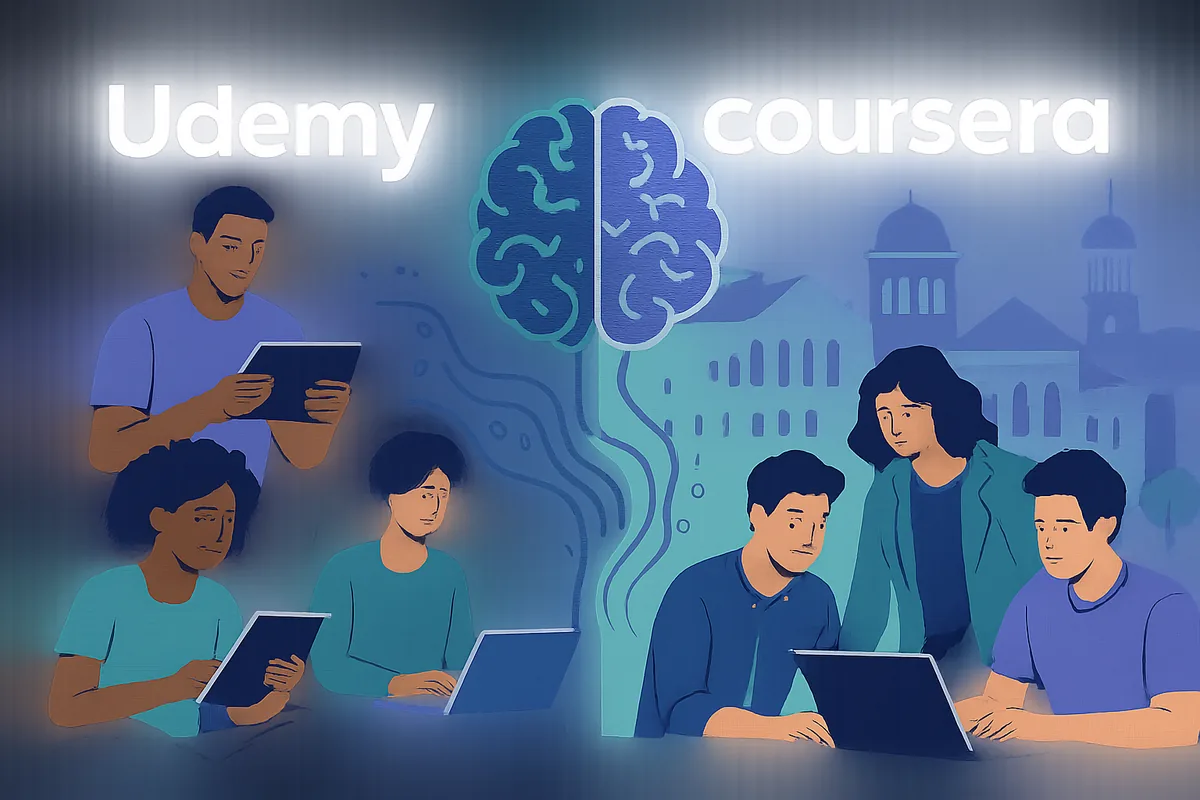
Udemy is an open marketplace where independent instructors publish courses, while Coursera partners with universities and companies to offer more structured, credentialed learning paths. That structural difference explains most of the practical tradeoffs between them.
Udemy's open model means huge variety and low prices, but inconsistent quality since anyone can publish a course. Coursera's partnership model means more consistent quality and more recognized credentials, at a higher cost and with more of a fixed structure to follow.
Udemy vs Coursera for AI beginners at a glance
| Factor | Udemy | Coursera |
|---|---|---|
| Course creators | Independent instructors, quality varies | Universities and industry partners |
| Cost model | One-time purchase per course, frequent discounts | Subscription or per-course, generally higher cost |
| Structure | Self-paced, standalone courses | Structured paths, some with deadlines |
| Access | Lifetime access after purchase | Free to audit many courses; paid tier for graded work and certificates |
| Credential weight | Certificate of completion, modest weight with employers | Certificates and Specializations, often more recognized |
| Best for | A specific skill, quickly, on a budget | A structured path with more built-in credibility |
What are the real advantages of Udemy for beginners?
Udemy's biggest advantages are affordability, variety, and lifetime access once you buy a course. Frequent discounts make even a full course a low-cost experiment, and the sheer range of topics means you can find something narrowly focused on almost any AI skill.
The tradeoff is that course quality varies significantly since anyone can publish. Reading recent reviews, checking the instructor's background, and previewing a free lesson before buying are worth the extra few minutes. A course with thousands of recent, detailed reviews is a safer bet than one with only a handful of ratings, regardless of how polished its marketing page looks.
What are the real advantages of Coursera for beginners?
Coursera's biggest advantages are consistent course quality, structured learning paths called Specializations, and credentials that carry more weight with some employers since courses come from named universities and companies. Many courses are free to audit, which is worth trying before paying.
The tradeoff is a higher cost for graded work and certificates, and a more academic pace that can feel slower than a beginner exploring casually might want. Specializations also require completing several courses in sequence, which is a bigger time commitment than a single Udemy course.
What should you actually check before enrolling in a course?
Before paying for anything on either platform, check the course description for a clear list of what you will be able to do afterward, not just a list of topics covered. A course that promises a specific, checkable outcome is easier to evaluate than one that only lists buzzwords.
- On Udemy: read a sample of recent reviews, not just the average rating, and check whether the instructor has real experience applying what they teach.
- On Coursera: check whether the course is free to audit before committing, and read the syllabus to confirm the pace matches how much time you can realistically commit each week.
- On either platform: look for a reasonable refund or audit policy so a bad fit does not cost you much to discover.
This small amount of upfront vetting matters more than the platform choice itself, since a well-vetted course on either platform will serve you better than a poorly chosen one on whichever platform has the better general reputation.
Does the platform matter more than your actual goal?
No. The platform matters less than knowing specifically what skill gap you are trying to close before you pay for anything. A vague goal like "learn AI" leads to picking the wrong course on either platform, while a specific goal like "get comfortable writing effective prompts" points you toward a short, focused option.
Our free prompt engineering guide and easy start guide to AI for beginners are both free ways to figure out your actual gap before spending money on either platform.
Should beginners exhaust free resources first?
Yes. Free introductory courses, official AI provider documentation, and hands-on practice with free tools cover most of what a beginner actually needs, and using them first tells you exactly what a paid course should focus on. This is the honest order of operations, even though it is the opposite of what course marketing usually suggests.
Once you have used free resources and still have a specific gap, a paid course on either platform becomes a much better investment because you already know what you are trying to get out of it. Our guide to whether AI bootcamps are worth it applies the same logic to a bigger financial commitment.
What skills are worth prioritizing regardless of platform?
For most non-technical beginners, prompt engineering and basic no-code automation matter more day to day than deep technical topics like the math behind neural networks. Those foundational, practical skills apply immediately, whereas more academic AI topics mostly matter if you are aiming for a technical role.
Our plain-language guide to machine learning, deep learning, and neural networks is a good free way to get oriented on the technical side without committing to a full course.
What if you are choosing a course later in your career?
If you already have years of experience in your field, look for courses that build AI literacy on top of what you already know rather than starting you over from zero. A general "intro to AI" course is less valuable to an experienced professional than one focused on applying AI to a specific domain or workflow you already understand.
Neither Udemy nor Coursera specifically targets this angle, so it is worth reading course descriptions closely with that filter in mind rather than assuming a popular, general-audience course is automatically the right fit. Our guide to staying relevant for the 40+ workforce goes deeper on why pairing experience with AI literacy is a genuinely distinctive combination, regardless of which platform you eventually choose for structured learning.
Next step: for the full realistic AI learning path, including when a paid course actually makes sense, visit our learn AI hub.